Napata
Gebel Barkal and the Sites of the Napatan Region comprise five archaeological sites on both sides of the Nile in an arid area considered part of Nubia. Together they cover an area more than 60 km long. The sites (Gebel Barkal, Kurru, Nuri, Sanam and Zuma) represent the Napatan (900 – 270 BC) and Meroitic (270 BC – 350 AD) cultures of the second kingdom of Kush. They include tombs, with and without pyramids, temples, burial mounds and chambers, living complexes and palaces. They exhibit an architectural tradition that shaped the political, religious, social and artistic scene of the Middle and Northern Nile Valley for more than 2000 years (1500 BC- 6th Century AD).
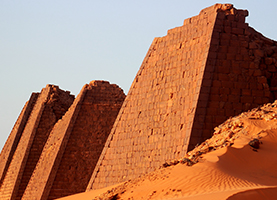
The pyramids, tombs, temples, palaces, burial mounds and funerary chambers set in the desert border landscape on the banks of the Nile, are unique in their typology and technique. The remains, with their art and inscriptions, are a testimony to a great ancient culture that existed and flourished only in this region.
Gebel Barkal has been a sacred mountain since New Kingdom times (ca. 1500 BC). The Kushite believed that their State God Amon resided in this “Holy Mountain”. Today, the mountain is locally named (Gebel Wad el-Karsani) after a Muslim sheikh (saint) buried near the 100m high, flat-topped sandstone rock. The mountain is closely associated with religious traditions since the tomb of this sheikh is still being visited by the local people for blessings.